Back to Projects
OYU AI Digital Employee
B2B ENTERPRISE SAAS

OYU AI Digital Employee

OYU AI – Digital Employee Platform

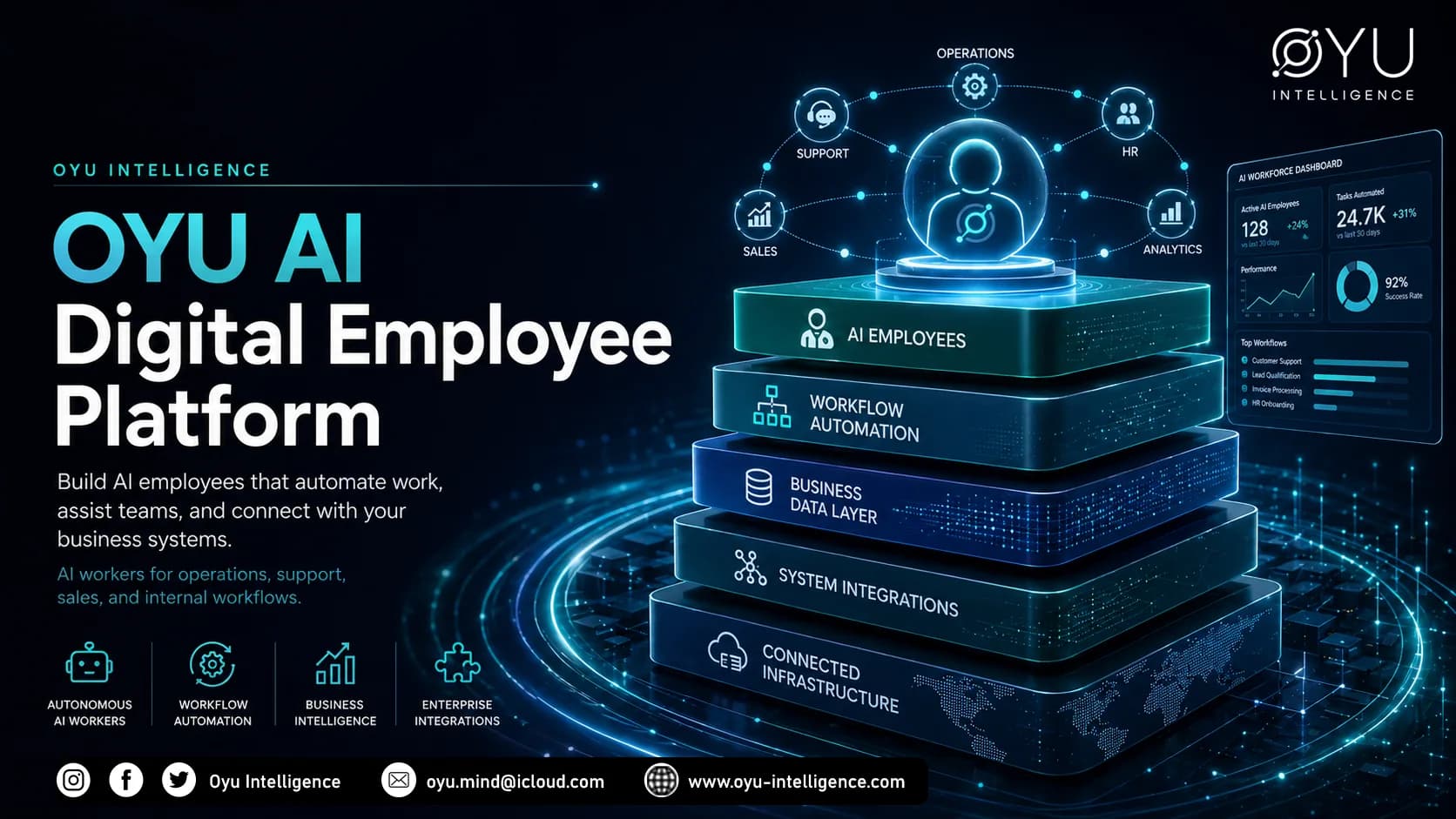
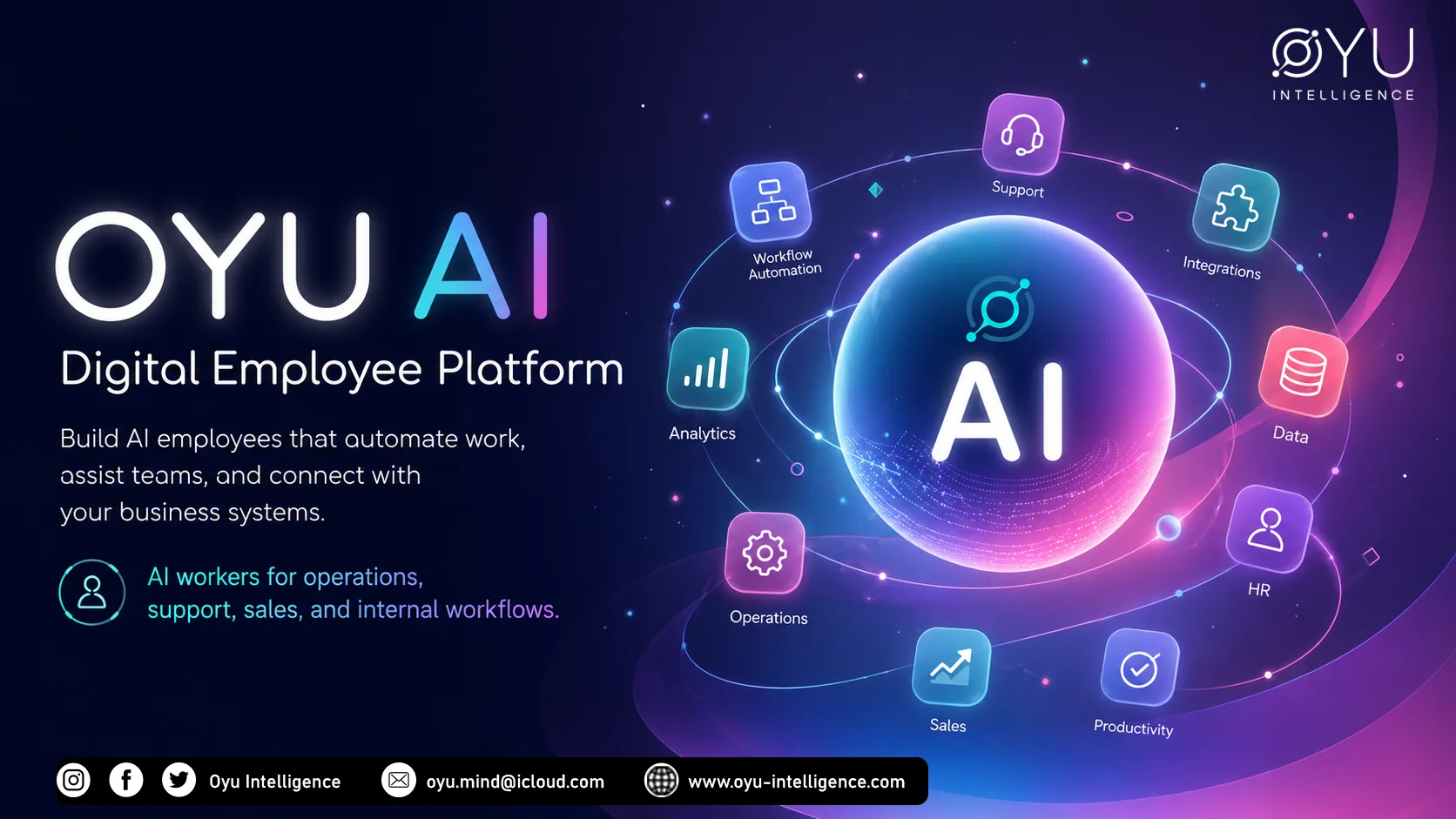
An enterprise AI workforce platform for creating, training, supervising, and deploying role-based digital employees.

Enterprise-grade AI workforce platform for companies

Key Features

Role-Based AI Employees

AI interns, specialists, and managers with scoped permissions and responsibilities.

Secure System Integration

Connects to CRM, ERP, email, documents, Slack, and other company systems.

Human Approval Workflow

Keeps people responsible for critical decisions while AI handles the work.

Project Information

Project Type and Positioning

Category: B2B Enterprise SaaS Platform

Positioning: Enterprise-grade AI workforce platform for companies

Primary Users: Businesses, enterprise teams, operations teams, sales teams, customer support teams, and management teams

OYU AI – Digital Employee Platform is positioned as a professional business platform that enables organizations to create, train, manage, and supervise AI-powered “digital employees.” These AI employees are designed to perform real business tasks, connect with internal company systems, and support teams by automating repetitive, time-consuming, and data-heavy work.

Project Overview

OYU AI – Digital Employee Platform is an enterprise-grade SaaS platform designed to help companies build and deploy AI digital employees inside their organization. These AI employees can be assigned specific roles, trained on company-specific information, and connected securely to internal tools such as CRM systems, ERP systems, email platforms, document repositories, Slack, and other business applications.

The platform is not simply a chatbot. It is designed as an operational AI workforce layer that can understand company data, execute tasks, collaborate with other AI agents, and support human employees in daily business operations. The system can be configured to include different levels of AI roles, such as AI Interns, AI Specialists, and AI Managers, each with defined responsibilities and access permissions.

Problem or Opportunity Addressed

Many companies lose significant time and money on repetitive administrative and operational work. Common examples include email classification, copying data between systems, preparing routine reports, updating CRM records, scheduling meetings, and searching through internal documents.

The platform addresses several major business problems:

First, companies face operational inefficiency because employees spend too much time on repetitive tasks that do not require strategic human judgment.

Second, companies face human resource limitations because recruiting, training, and retaining skilled employees can be expensive and difficult.

Third, many organizations have large amounts of unused internal information, often called dark data. This includes valuable data stored across CRM systems, ERP systems, documents, emails, and internal communication tools, but not actively used for decision-making.

Fourth, modern businesses increasingly require 24/7 availability, especially in customer service, sales, internal support, and operations. Human teams often cannot provide continuous service without high cost.

Objectives and Goals

The main objective of OYU AI – Digital Employee Platform is to help companies increase productivity by introducing AI employees that can perform defined business tasks safely, efficiently, and continuously.

Key goals include:

  • Automating repetitive and low-value operational tasks.
  • Reducing manual workload for human employees.
  • Allowing companies to use internal data more effectively.
  • Providing AI employees that can be trained on company-specific knowledge.
  • Enabling AI agents to work together as a coordinated digital team.
  • Supporting human decision-making rather than fully replacing human judgment.
  • Improving response times in customer support, sales, and internal operations.
  • Creating a secure enterprise AI environment suitable for sensitive business data.

Target Audience and Beneficiaries

The platform is designed for medium to large businesses that want to improve productivity through AI automation.

Primary target users include:

  • Corporate executives seeking operational efficiency.
  • Operations teams managing repetitive workflows.
  • Sales teams needing CRM updates, lead tracking, and communication support.
  • Customer support teams requiring faster response times.
  • HR teams managing internal communication and document workflows.
  • Finance and reporting teams needing automated summaries and data consolidation.
  • Technology teams responsible for system integration and security.
  • Businesses with large internal knowledge bases and disconnected systems.

The main beneficiaries are organizations that need scalable, secure, and role-based AI automation within their internal business environment.

Scope of Work

The scope of the platform includes the creation, deployment, management, and supervision of AI digital employees within an organization.

The core scope includes:

  • Connecting securely to company systems through APIs.
  • Training AI agents on private company data using a secure retrieval-based approach.
  • Assigning specific roles, permissions, and responsibilities to AI employees.
  • Enabling AI agents to perform practical tasks such as sending emails, updating CRM records, preparing reports, and scheduling meetings.
  • Supporting multi-agent collaboration where multiple AI employees can communicate and divide work.
  • Creating supervision workflows where humans can review, approve, or reject AI-generated actions.
  • Providing administration tools for monitoring AI performance, access, usage, and security.

Key Features and Functionalities

Key features include:

Secure System Integration

The platform can connect to internal business systems such as CRM, ERP, email, documents, Slack, and other tools through APIs. This allows AI employees to work with real business information instead of operating in isolation.

Private RAG-Based Learning

The platform uses a private retrieval-augmented generation approach. In simple terms, this means AI employees can answer and act based on internal company documents and data without permanently exposing that information to external systems.

Task Execution

AI employees can perform real business tasks, including drafting and sending emails, preparing reports, updating records, summarizing documents, scheduling meetings, and organizing information.

Role-Based AI Workforce Structure

The platform supports different AI roles such as AI Intern, AI Specialist, and AI Manager. Each role can have different levels of responsibility, access, and approval requirements.

Multi-Agent Architecture

Multiple AI employees can collaborate with one another. For example, one AI agent may analyze data, another may prepare a report, and another may draft a client-facing message.

Human-in-the-Loop Workflow

The platform is designed so that AI can complete a large portion of the work, while humans remain responsible for reviewing and approving important decisions. This increases safety, accountability, and trust.

Enterprise Security Controls

The platform is intended to support enterprise-grade security, access control, permission management, and private data processing.

Technology Stack and Architecture

Confirmed / Mentioned Technology Concepts:

  • SaaS platform architecture
  • API integrations
  • Private RAG
  • Multi-agent architecture
  • Human-in-the-loop workflows
  • Enterprise security model

Recommended / To Be Confirmed Technology Stack:

  • Frontend: Next.js, React, Tailwind CSS
  • Backend: Python, FastAPI, or Node.js
  • Database: PostgreSQL
  • Vector Database: Pinecone, Weaviate, Qdrant, or pgvector
  • Authentication: Clerk, Auth0, or enterprise SSO
  • Integrations: CRM APIs, ERP APIs, Slack API, Google Workspace API, Microsoft Graph API
  • Queue and Background Processing: Redis, Celery, BullMQ
  • Cloud Infrastructure: AWS, Azure, Google Cloud, or private deployment
  • Monitoring: Datadog, Grafana, Prometheus, or similar
  • Security: Role-based access control, encryption, audit logs, data governance policies

Current Status and Achievements

The provided information defines the project as a core flagship project. It has a clear business model, target market, enterprise use case, core differentiation, and proposed monetization structure.

Current achievements and defined strengths include:

  • Clear B2B SaaS positioning.
  • Defined AI digital employee concept.
  • Clear problem-solution fit for enterprise productivity.
  • Defined role structure for AI employees.
  • Strong differentiation through multi-agent collaboration, private RAG, and human-in-the-loop approval.
  • Established pricing model ranging from monthly AI employee subscriptions to enterprise onboarding fees.

Challenges and Solutions

Challenge: Enterprise Data Security

Companies may be concerned about giving AI systems access to internal data.

Solution:

Use private RAG, secure API connections, permission-based access, audit logs, encryption, and optional private or on-premise deployment for sensitive clients.

Challenge: Trust and Accuracy

Businesses may hesitate to allow AI to perform real tasks without human oversight.

Solution:

Use human-in-the-loop workflows where AI performs most of the work, but humans approve final actions when necessary.

Challenge: Integration Complexity

Different companies use different CRM, ERP, email, and document systems.

Solution:

Develop modular integration connectors and offer enterprise onboarding packages to customize integration.

Challenge: Role and Permission Management

AI employees must not access information beyond their authorized role.

Solution:

Implement strict role-based access control and permission management for every AI employee.

Business Model and Monetization

The proposed business model is a subscription-based SaaS model.

Revenue streams include:

  • Monthly subscription per AI employee.
  • Pricing range: approximately $49 to $499 per AI employee per month, depending on capability level.
  • Enterprise onboarding fee: approximately $2,000 to $10,000 as a one-time setup fee.
  • Possible future revenue from premium integrations, advanced analytics, private deployment, and dedicated enterprise support.

Expected Outcomes and Impact

Expected outcomes include:

  • Reduced operational costs.
  • Faster execution of repetitive tasks.
  • Better use of internal company data.
  • Improved employee productivity.
  • Enhanced customer service availability.
  • More consistent business processes.
  • Increased scalability without proportional increases in staffing costs.
  • Stronger decision support for managers and teams.

The long-term impact is the creation of a digital workforce layer that helps companies operate more efficiently, intelligently, and continuously.

Strategic Differentiation

OYU AI – Digital Employee Platform is differentiated by its focus on enterprise-grade AI employees rather than general-purpose chatbots. Its strongest differentiators include private company-data learning, multi-agent collaboration, role-based AI teams, and human-controlled approval workflows.

The platform’s value comes from combining automation, enterprise security, internal data intelligence, and practical task execution into one business-ready AI workforce system.

Audience

Businesses, enterprise teams, operations teams, sales teams, customer support teams, and management teams

Year

2026

Category

B2B ENTERPRISE SAAS

Tech Stack

Next.jsFastAPIPostgreSQLPrivate RAGMulti-Agent AI

Start a project?

Let’s turn your vision into a reality with AI-powered solutions.

Contact Us

Gallery

OYU AI Digital Employee
OYU AI Digital Employee screen 2

Related Projects