
Practical Uses and Limits of AI in Business

A plain-language overview of where AI can assist with service, data, marketing, and repeated work—and where evidence and human review are still required.
Practical Uses and Limits of AI in Business
"AI" covers several techniques for recognizing patterns, generating content, ranking options, and assisting with decisions. A business result does not come from the label alone; it depends on the selected task, source data, workflow controls, and how output is checked.
What is Artificial Intelligence?
In this article, AI means software that uses statistical or machine-learning models to classify, generate, rank, extract, or forecast. The model does not define the business problem, data rights, acceptable error rate, or person responsible for the result.
Where AI Can Assist
Three common candidate tasks are:
-
Customer service: A system can classify requests, retrieve approved information, or draft a reply. Sensitive or uncertain cases still need escalation, and response quality must be measured.
-
Data analysis: Models can assist with classification, summaries, and question interfaces when definitions and source records are controlled. They do not repair poor data or replace accountable analysis automatically.
-
Marketing: AI can help produce variants or group approved audience data. Any effect on conversion or sales requires an experiment; personalization also creates consent and privacy obligations.
For each task, compare the assisted process with the existing one. Useful measures may include completion time, reviewed error rate, escalation volume, cost, or customer outcome.
Treat Forecasts as Questions
Automation in manufacturing, transport, logistics, and healthcare was widely discussed when this article was written. Those fields have different safety, evidence, and regulatory requirements, so they should not be grouped into one promise of progress.
-
Automation: Which step is being automated, and does measured productivity or error rate improve?
-
Transport and logistics: What operating environment, fallback behavior, and accountable operator are required?
-
Healthcare: What clinical evidence, qualified review, privacy control, and approval applies to the intended use?
Adopting a tool early does not guarantee an advantage. A narrow implementation with a measurable result is stronger evidence than timing or branding.
Why AI Matters to Your Business
The relevant question is not whether a business "uses AI." It is whether a particular model-assisted step improves a defined process enough to justify its errors, operating cost, data exposure, and review burden.
Conclusion
AI is already available as software infrastructure, but each business use still needs a clear owner, test data, permissions, failure handling, and an acceptance measure.
Oyu Intelligence uses this framework to evaluate whether a fixed automation, a model-assisted workflow, or conventional software is the appropriate solution.

Read Next
Related notes

Adversarial Poetry and AI Safety: What a 25-Model Study Found
In a preprint, 20 hand-written poetic prompts produced a 62% average attack-success rate across 25 models; a larger 1,200-prompt conversion test averaged about 43%.

PROMPTFLUX: What Google’s Report Says About AI-Assisted Malware
Google reported an experimental VBScript dropper that queried Gemini to rewrite and obfuscate its code. The sample was still in development, and Google did not report a successful device or network compromise.
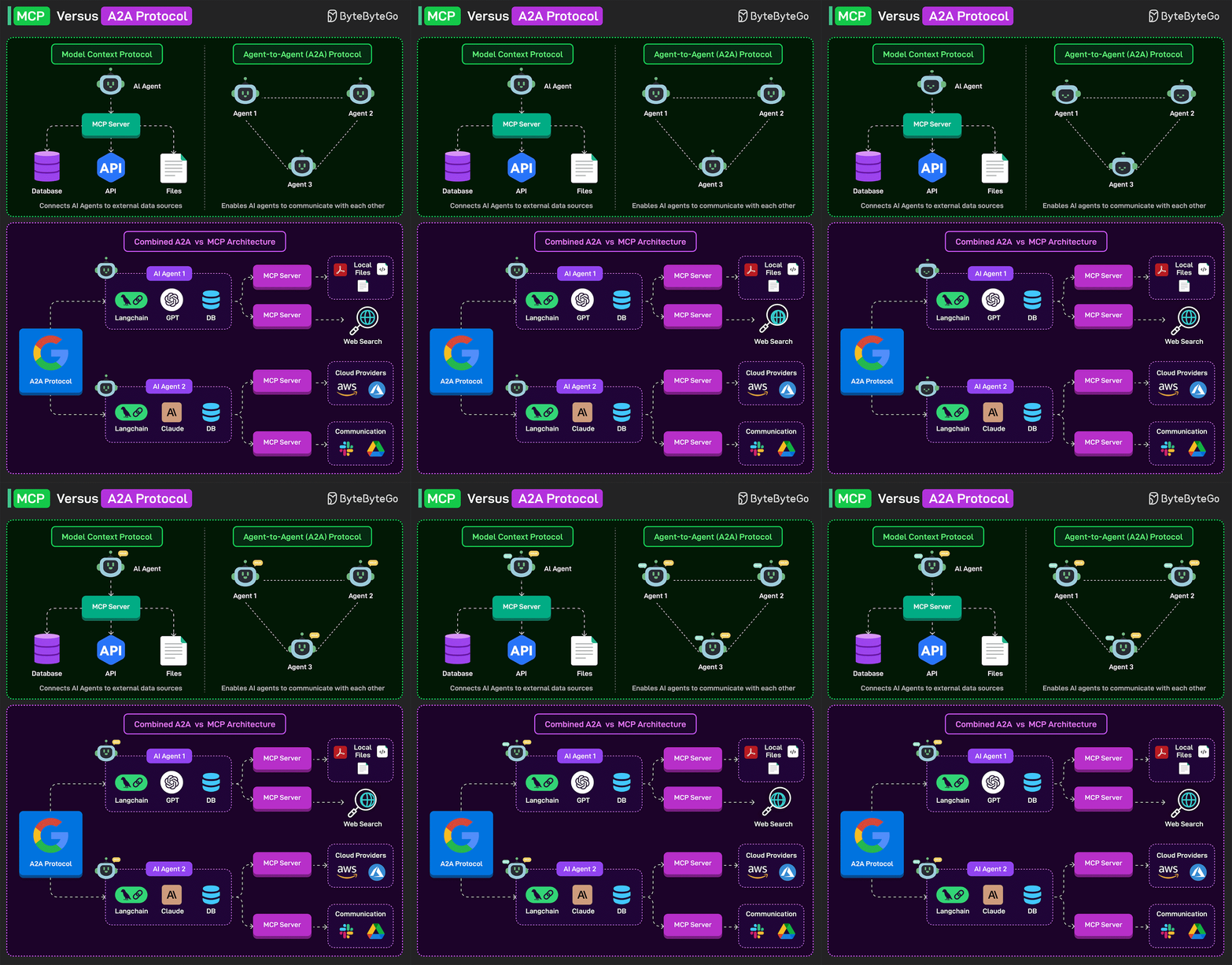
A Design Question for Multi-Agent Systems: When Is Language the Wrong Interface?
An engineering essay on where free-form agent dialogue can lose intent, and when schemas, state machines, or typed messages may be easier to inspect.