
Automation, AI Workflows, and Agents: A Practical Boundary
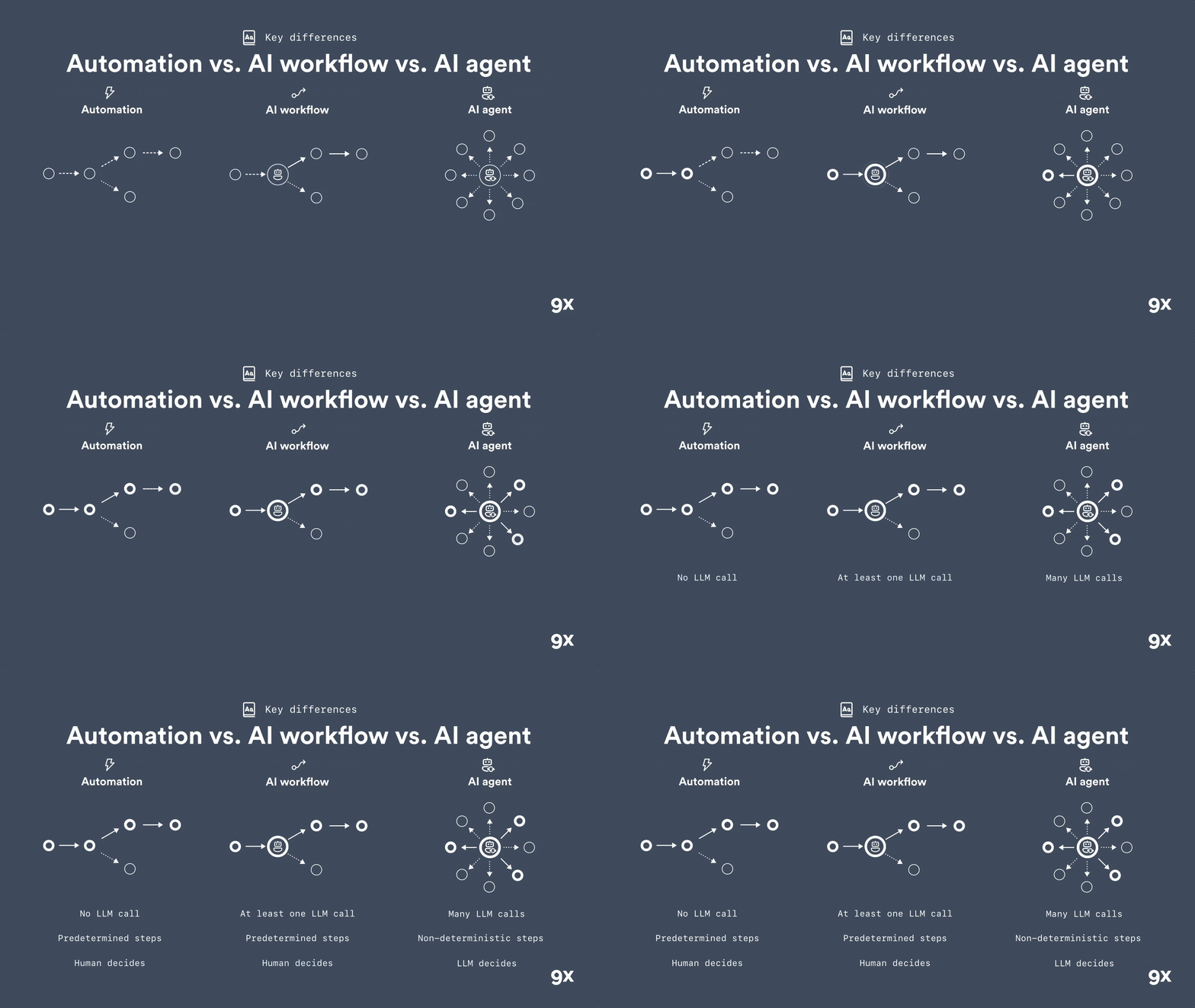
A concise way to choose between fixed rules, model-assisted steps, and systems that select among tools—without calling every workflow an agent.
Automation, AI Workflows, and Agents: A Practical Boundary
These terms are used inconsistently, but one practical distinction is how much of the path is defined before the system runs:
→ Automations follow predefined rules or state transitions. → AI workflows keep an overall path but use a model for selected interpretation or generation steps. → Agents can select among allowed actions or tools at runtime, within permissions and stopping rules set by people.
At the core this means there are three key differences:
1. LLM Calls
Automations do not need an LLM. They may still use conventional software or machine-learning services while following predefined logic.
AI workflows call an LLM at least once during their execution. These calls are integrated into specific steps of the workflow.
AI agents may call a model several times to plan, choose a permitted tool, inspect a result, or decide whether to continue. Calling a model repeatedly is not enough by itself to make a system an agent.
2. Execution Steps
Automations and AI workflows both follow predetermined paths. The sequence of operations is defined in advance and doesn't change during execution.
AI agents choose among a bounded set of next steps at runtime. The tool list, permissions, budget, approvals, and termination conditions should still be designed in advance.
3. Decision-Making
With both automations and AI workflows, HUMANS decide what happens. The logic, rules, and workflow steps are all predetermined by human developers.
With AI agents, a model proposes or selects the next allowed action. People remain responsible for the surrounding policy and for approval where the consequence matters.
Why These Differences Matter
These differences matter significantly when choosing the right approach for your business needs. If you can solve it with an automation or an AI workflow - you shouldn't build an agent.
Most processes do not need an agent to be automated. Agents add complexity, unpredictability, and cost that may not be necessary for straightforward, well-defined tasks.
When to Use Each Approach
Use Automations when:
- The process is completely rule-based
- Steps are always the same
- No AI interpretation is needed
- Predictability is crucial
Use AI Workflows when:
- You need AI for specific steps (like content generation or analysis)
- The overall process flow is predictable
- You want to combine AI capabilities with traditional automation
- You need some intelligence but want to maintain control
Use AI Agents when:
- The task requires complex reasoning at multiple steps
- The path to completion varies significantly based on context
- You need autonomous decision-making
- The problem is too complex for predetermined workflows
Conclusion
The useful choice is usually the least complex design that can complete the job reliably. Start with fixed rules, add model-assisted steps where interpretation is needed, and use agent-like action selection only when variable paths create clear value.
In Oyu Intelligence projects, this distinction is used as a scoping tool rather than a maturity ladder: an agent is not automatically better than a well-defined workflow.
This insight was shared by Alexandre Kantjas on LinkedIn

Read Next
Related notes

Adversarial Poetry and AI Safety: What a 25-Model Study Found
In a preprint, 20 hand-written poetic prompts produced a 62% average attack-success rate across 25 models; a larger 1,200-prompt conversion test averaged about 43%.

PROMPTFLUX: What Google’s Report Says About AI-Assisted Malware
Google reported an experimental VBScript dropper that queried Gemini to rewrite and obfuscate its code. The sample was still in development, and Google did not report a successful device or network compromise.
A Design Question for Multi-Agent Systems: When Is Language the Wrong Interface?
An engineering essay on where free-form agent dialogue can lose intent, and when schemas, state machines, or typed messages may be easier to inspect.